Showing posts with label george fox. Show all posts

Saturday, 4 January 2020

Reflection on ‘Maxim 4’ (Fox is no authority)

Fox is no greater authority than you or I, nor was his access to the true authority any greater than ours.
Maxim 4
I was not surprised that this one was controversial for some Friends. I suppose I wish I were surprised, but really I was more relieved that it seemed very few found it challenging.
George Fox is often spoken of as the founder of the Religious Society of Friends. He was certainly a charismatic leader (and for those into Christian theology, that applies in both the everyday and technical sense), and the proto-Quakers of the North West of England did coalesce around him. Yet it is in the very nature of what he taught – and he wasn’t the only one teaching it, mind you – that we not ascribe authority to other people. The message being shared by various spiritual teachers of the time, including Fox, was that we all had access to the ultimate source of teaching and authority. Not only did we not need intercessory priests, as asserted by Luther and Calvin, but every single one of us could sit down and find the still small voice within, and know some measure of God’s guidance and God’s will (at the time, there would have been no question as to whether or not it should be identified as such).

Thursday, 19 July 2018

What I Fear

A peacock stands on a stone pedestal in a pleasant garden, with a pond in the background.
I have fears, when I write things like this. When I write down what I am led to write, or when I sit down to write deliberately, certain worries are always on my mind.
There are the usual worries of anyone writing things others will read, of course. Have I written this well? Is it understandable? Will people criticise harshly, perhaps even mock me?
When writing down ministry, there are extra worries. Have I faithfully rendered that which has been given to me? How sure am I of the leading?

Tuesday, 24 April 2018

What Are "The Things Which Are Eternal"?

A long exposure photograph of a cloudless night sky, showing the path of apparent motion of stars in the sky as the Earth rotates.
“Seek to know one another in the things which are eternal”. It's a popular phrase, made particularly well-known by it's inclusion in Britain Yearly Meeting's Advices and queries, number 18. It falls easily from our lips, and a lot of people seem to put a lot of emotional investment in the idea, but what does it mean?
In my experience, Friends often seem to use the phrase in a way that is rather non-specific. Much like “that of God in every one”, its meaning seems to be in the moment, in whatever form is useful to the speaker. Usually, it seems to add a sort of warm fuzz to the idea of getting to know one another, that it means getting to know one another in a deep sense, rather than a superficial one. You might know what someone does for living, but it is knowing them in a deeper way to find out that they paint landscapes, or write poetry. This is a reasonable distinction to make, and the idea that we, as Friends, should know one another well is a laudable one. Is this really “the things which are eternal”? Certainly, there's a degree to which meanings change with time and context, especially as society changes – or as our Religious Society changes.

Sunday, 25 February 2018

The Death of Fox

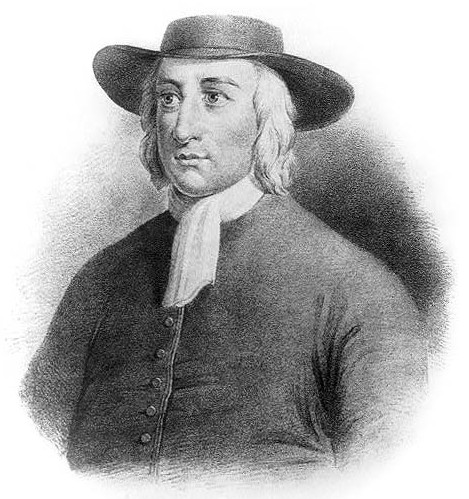
Engraving of George Fox
From the title of this post, you might have supposed that it was going to be a sort of tailpiece biography, covering the time shortly before and after the actual death of George Fox. Another possible interpretation would be that I was, out of all character, joining in with the sporadic habit of some Quakers online, bemoaning how unlike Fox most Quakers are today.
In either case, I'm afraid you're going to be disappointed. Rather, it is a reference to The Death of the Author, an essay by the French literary critic and author Roland Barthes (it's original French title itself being a play on the title of Le Mort d'Arthur, but that's too tangential a path for me to dive down here), and of the literary theory concepts that derive from it.
The essential principle of the essay, and the related (but separately posited) theory of the “intentional fallacy”, is that the author is not the authority when it comes to the meaning of a piece of work. Once an author has created a work, they might tell you what their intent was, you might infer it from other sources, but intent is not the determining factor of meaning. I don't say that this theory is universally accepted in the study of literature; I also probably don't understand it perfectly, not having studied literary theory or analysis, so please don't rely on my explanation (or lecture me too harshly if you know it better – I'm glad to learn more, but please keep it friendly).

Friday, 24 November 2017

What Is "That of God in Every One"?

Engraving of George Fox
We often quote George Fox, but do we do so
without regard for what he meant?
One of the most well-known, and to many well-loved, traditional Quaker phrases is “that of God in every one”. Perhaps because of the advance of liberal sensibilities, perhaps because the phrase is used in isolation so often, rather than in its usually-cited context, the meaning of the phrase seems to have become rather woolly, disconnected from how it was originally meant, and – to my mind – less than useful.
Nowadays, people often seem to take it, or use it, to suggest that there is something good about each person, that there is something worthwhile or even laudable about each of us in this strange species we call “human”. That's an idea, as far as it goes, and it's often something worth pointing to, but people struggle with it when relating it to historical (or modern) figures in whom it is difficult to see any redeeming quality – be it serial killers, genocidal dictators, or ethically and morally bankrupt figures in business and politics. It's still valuable even then, as the reminder that there are essential principles to our treatment of people, now enshrined in law in many jurisdictions, that cannot be compromised however awful we think the people in question might be. However, it misses what I consider to be both the essence of what Fox likely meant in that famous quote, and the most useful interpretation we can put on it today.
If you enjoy this blog, or otherwise find it worthwhile, please consider contributing to my Patreon. More information about this, and the chance to comment, can be found in the post announcing the launch of my Patreon.