Friday, 27 August 2021

Quakers and Practical Action

A wide range of wood-working tools mounted on a wall.
I have a very strong feeling about this, as strong as that when I am called to minister. I reflected and tested it, however, and it was clear to me that it is actually simply a strong feeling of my own. Nonetheless, like other deliberate writing on this blog, it’s something I want to share – something I feel is of value to share among Friends, and to be public about to any non-Quaker audience who happens upon my blog for whatever reason.

We Quakers can talk a good talk. But when it comes to practical action, we often seem to struggle. Oh, when we do take practical action we can be very good at it (and we can be ineffective – no-one is effective all the time), but actually taking the step of trying to take practical action seems to be difficult for us. I cannot count the times, in Meetings for Worship for Business, that I have been frustrated – we have a clear leading that something needs to be done, but ministry on what to do or how to do it is sparse, and often, to speak plainly, wishy-washy. Where it does occur, it is often in such a minority that, quite understandably, the clerks do not feel able to see it as the sense of the Meeting and include it in the minute.

Monday, 23 August 2021

Status, Power, and Betrayal of the Spirit

A stylised figure stands behind a lectern, wearing a tie, arms outstretched.

Not every decision can be referred to the whole of a body corporate, such as a Quaker Meeting. It is impractical in some cases, for instance because of the need for a decision in a short time; it is implausible in others, for instance because of the need for those making the decision to have a clear understanding of certain facts or law; it is simply impossible in others, because it is not ripe for discernment in a large group, in the Quaker case, or for a vote or consensus decision in most other contexts, because it requires preparatory work. That preparatory work will inevitably mean making preliminary decisions, excluding some possible options.

So we have people in positions that, though we may hesitate to use the term, are positions of leadership. Elders lead our spiritual development, clerks lead the process of discernment, premises committees lead on the maintenance and use of our property, even librarians lead by making decisions on what to deliberately acquire for the library – and occasionally what to deliberately exclude when a copy is donated. They are positions of status, as respect is not unreasonably given to those whose names have been discerned to serve in certain roles – though we serve most faithfully when we deny, especially to ourselves, the status of a role in which we serve.

Friday, 13 August 2021

My Experience of Gender

A featureless cartoon image of a human lies face down on the floor, as if trying to move or rise, with a large Mars glyph, representing the masculine, resting on their back. The figure could be interpreted as struggling, or not.
A note in advance: this is categorised as both ‘writing’, the tag I use for deliberate writing, and as ‘ministry’, the tag I use for things I am led to write in the same manner as being led to speak in Meeting for Worship. This is not a typical tagging pattern on my blog, and it arises for a simple reason. I am strongly led to write about my experience of gender at this time, but there is much more leading as to what I should write – though I was still guided by the Spirit more than I am generally in deliberate writing. This has been written deliberately, not entirely with the guidance of the Spirit, but definitely at the prompting of the Spirit.

I grew up in about as much of a gender-expectation-free environment as one could get, in the time and place I grew up. This is, I think, largely a result of my mother; my father never had any objections to it, as far as I was aware, but I’m not sure he would have been as encouraging without my mother’s influence. I had ‘boy’s toys’ and ‘girl’s toys’. As a small child playing dress-up, I gleefully mixed costumes and costume elements without regard for the conceptual gender that they belonged to. I even experimented with makeup as a small child, as well as in my teens within subcultures in which such exploration was acceptable. I may have grown up in a mostly male household, but my mother was always the most dominant figure in it.

Thursday, 12 August 2021

Nominations, Mandates, Power and Service

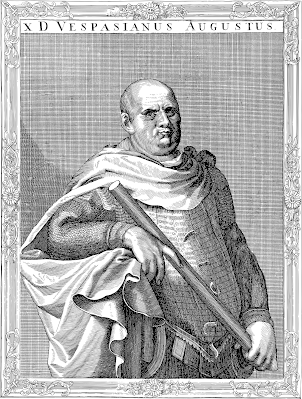
Line engraving of the Roman Emperor Vespasian
Engraving of Vespasian, Roman Emperor,
by unknown artist circa 17th-18th century

We Quakers have a somewhat idiosyncratic way of getting a lot of our work done. In any organisation, in any community, there will be certain jobs that need to be done for that community – and some way of deciding who does the jobs and in what way.

In your stereotypical secular organisation, the main ongoing jobs are codified into specific positions – chair, secretary, treasurer, social secretary, communications officer, and so forth. Any work that needs doing is either in the remit of one of these people, or an executive committee decides who will do it. Who serves in the various named positions is usually a matter for election, though it is not unheard of for an executive committee for one year to designate the executive committee for the next, subject to ratification in general meeting, or for some or all of the positions to be filled ex officio by people with positions in other (typically constituent or affiliated) organisations. By and large, though, it comes down to something to some degree typically democratic – there is a vote of the membership to determine who serves in what role.

In less formal organisations, work is often done by whoever shows up. Decisions, be they by vote or consensus, are made at meetings by a self-selecting body of those who cared enough to show up. If the organisation wants a newsletter, someone volunteers to do it, and does so if no-one objects; when they cease to do so, someone else will offer – or not, and the work doesn’t happen, for good or ill.

Friday, 6 August 2021

An Unpopular Truth?

Broken glass

I know this won’t be popular with some Friends, though I don’t know how many, but I have to say it anyway.

I know this won’t be popular with some Friends, but that’s part of why I have to say it.

I understand why there’s a debate among British Friends about trans rights. About trans inclusion. About trans affirmation. I might not agree with it. I might think it’s been driven by interest groups who have deliberately provoked fear in society at large, who have played upon particular insecurities – well-justified insecurities – among some people. I might think that some of the groups against trans rights have unlikely bedfellows supporting them, and that they will regret it soon enough. Still, I understand it about as well as I think I can.

Thursday, 5 August 2021

It's Been a While

Illustration of a person silhouetted in profile, with illustration of brain overlaid. To the left are clocks and an hourglass, and in between are lightbulbs with brains.

I’ve been away from this blog for a while. I thought it might be appropriate to talk a bit about why. An exploration and reflection on the past 9 months or so. I also want to thank those who have continued to support my Patreon despite the lack of output for so long; this might be a matter of not noticing, forgetting they had supported it, but it might also be a deliberate decision to continue to support me in this small but very tangible way in spite of my output. For that I am profoundly grateful.

I did post some written ministry recently, but if you read the note at the bottom on when it was written, you will see that it was written as far back as June 2020. I was not completely dysfunctional by then, but was already struggling.

Wednesday, 4 August 2021

Dispute, Difference, Division

A close up of a crack in an asphalt surface, running left-right.
Division is inevitable,
Dispute unavoidable.
Unanimity: a pipe dream.
Every group, large or small,
Has from time immemorial,
Faced the same inevitable wall,
A contest adversarial.
The outcomes of dispute are few,
Though each seems different, too many to name.
Either one side conquers, the other gives way,
Or terms are reached irking both sides the same.

Tuesday, 3 August 2021

A Choice Between ‘Are’ and ‘Aren’t’

Transgender flag

“Trans women are women”.

That’s a statement I agree with. Also that trans men are men.

I acknowledge that it is a little simplistic, it misses nuance. There are things that differentiate trans women from those assigned female at birth, of course there are. But there’s one thing that makes me quite sure that it’s right to say that trans women are women.

Saturday, 19 December 2020

A Quaker Covid Christmas

Visualisation of the SARS-CoV-2 virus - a grey sphere, looking almost like it is made of yarn, with small orange blocks and larger flared red spikes on its surface.
Your latest Christmas Tree decoration?
(visualisation of SARS-CoV-2 virus by US CDC)

It’s Christmas time. It’s a pandemic. It seems to have quite a lot of people in something of a tizzy.

Our friends across the Atlantic have already negotiated this with their Thanksgiving holidays, when it is common – even traditional – for families to come together, even if they live far apart. Many families here in Britain are in the habit of doing the same at Christmas, and certainly families who do live near one another often get together in larger family gatherings than is their habit at other times of year. The fact it has become a secular holiday, as well as a sacred festival for most Christians, means that this extends over more of the population than one might think by looking at religious demographics.

To an awful lot of people, Christmas isn’t Christmas without household mixing. For the religiously observant, busy services on Christmas Eve bring many households into close proximity. For lots of people, religious or otherwise, Christmas is when family comes together, even if normally spread out. Students return to the family home for Christmas, and even those children who are grown and settled in new lives often do the same. Where the next generation has brought forth their own new generation, the older generation might be hosted by their children, and see their grandchildren. This is normal, expected even – to the extent that childless people who spend Christmas alone, even as a couple, are sometimes pitied at best, thought strange at worst. Charities put a lot of effort into making sure people who don’t want to spend Christmas alone – or who other people think oughtn’t to spend Christmas alone – don’t have to do so.

Wednesday, 16 December 2020

Covid, Mental Health, Relgion and Spiritual Communities

A person in yellow hazardous materials gear sits in an approximation of the lotus position.

The public health issues gripping the world have been hard on a lot of people – indeed, I would be surprised to find anyone who hadn’t experienced some sort of negative impact from the changes that Covid-19 has worked upon our lives. I’m sure, here in the UK, we’ve all heard from friends and relatives finding themselves homeschooling their kids with very little notice and usually equally sparse support. I expect more than a few of my readers have been in that position themselves, not just heard about it at one remove. People who have lost their job or had hours cut have obvious stress. People who thrive on social contact will have struggled with the limited ability to see other people. People who have had to restrict contact even more because of being at high risk, such as the UK’s ‘shielding’ category, will have had extra stress just getting essentials, and those who already relied on shopping deliveries have had to cope with slots being much harder to come by.

Those are the obvious sources of stress, of things that can affect people’s mental health. And those are just the tip of the iceberg.

Saturday, 20 June 2020

#BlackLivesMatter: A White British Quaker's Perspective

An engraving print depicting Black slaves being taken by white slave traders, including a family being split up.
'Slave Trade' by John Raphael Smith, after George Morland's
‘Execrable human traffick, or the affectionate slaves’
Recent events have brought back to wider public consciousness that rallying cry, “Black Lives Matter”. It comes from the United States of America, but its resonance is felt around the world. As we see from the incidents that prompt outcry, it is most easily associated with excess deaths of black people – but it’s about a lot more than that.
Now, most Quakers in Britain are white. Not all of us, by any stretch, but definitely most. We’re also mostly relatively educated, with a much higher incidence of post-graduate qualifications than the general population, and there’s a definite tendency towards being culturally middle class. This has a lot of results, some of which I’ve written about before, but one of them is a real difficulty in engaging with the deep issues that underlie the statement that Black lives matter. I’ve seen Quakers in public on social media respond to that simple statement with one of the most problematic responses that we see everywhere – that “all lives matter”.
Why is that statement a problem? After all, don’t we – with our pacifist tradition and believe in a sort of universal divinity – really fundamentally believe that all lives matter? Yes, of course we do. It would be silly to suggest otherwise. In fact, especially among Quakers, it’s so obvious that it doesn’t even need saying. So why do we need to say that Black lives matter?

Tuesday, 14 April 2020

The Choice of Judas?

A section of a painting of the Last Support, showing Judas reaching for food. The painting is considered to be in Byzantine style, though dating from circa 1100 CE.
Judas reaches for the food, School of Monte Cassino, c.1100
In keeping with my previous writings concerning ‘Times and Seasons’, and with conditions being so different from the usual at the moment, I have been reflecting on the Easter story.
I don’t have a great deal of skin in this game, not being a Christian or believing in the divinity of Jesus – or at least any more divinity than anyone else. Still, it is the tradition I grew up in. The irreligiosity of my family didn’t diminish the exposure to the story that one gets from wider society. It is a story that few who grew up in the UK, at least around the time I was doing so, could avoid knowing about.
Of course, without more study than even most Christians put into it, you get a very simplistic idea of the story. As with the Christmas story, the story we generally get through liturgy, or being taught in school, or seeing dramatic interpretations, is a sort of hodgepodge of the different gospel accounts. The journey into Jerusalem, assorted miracles, the Last Supper, the betrayal at Gethsemane. Yet all of these elements are different in different gospels, as I noted in previous writing concerning the Last Supper. Now, I am going to focus on the betrayal of Jesus by Judas, a story whose meaning I’m not sure is appreciated as best it might be – and a story that has been used down the centuries to justify injustice.

Monday, 23 March 2020

Meeting Without Meeting

A woman sits cross-legged on the floor under a window, with a laptop on her lap and a cup of coffee in one hand, while the other operates the laptop.
Well, life is different right now, isn’t it?
For context, just in case people stumble into this once life is back to normal (whatever that ends up looking like), this is written and published during significant social distancing restrictions in Britain due to the Covid-19 pandemic. For the benefit of the international audience reading this immediately, as well as a future audience, we’re currently (22nd March 2020) being asked not to gather in any sort of group, not to socialise, to work from home if possible, not to go out except as necessary or if we can ensure a minimum 2m distance from anyone else (they want us to still get exercise seems to be the main reason for that). Workplaces are shutting down or going to remote working. Bars, restaurants, theatres, cinemas, cafes have all been asked to close, except for selling take-away food. The government is offering grants to employers to help cover salaries of people who might otherwise be laid off. Panic buying continues to empty supermarket shelves of toilet rolls, soap, some tinned goods, and bread (among other things).
Now, in the context of all of those other things, this next feature is fairly unimportant – but it’s the reason for this blog post, so it’s going to have some prominence.
If you enjoy this blog, or otherwise find it worthwhile, please consider contributing to my Patreon. More information about this, and the chance to comment, can be found in the post announcing the launch of my Patreon.